


- Overview
Leadership, Statecraft and Grand Strategy Advanced Credential (LSGS)
Executive Education | Bandaranaike Academy for Leadership and Public Policy (BALPP)
Overview
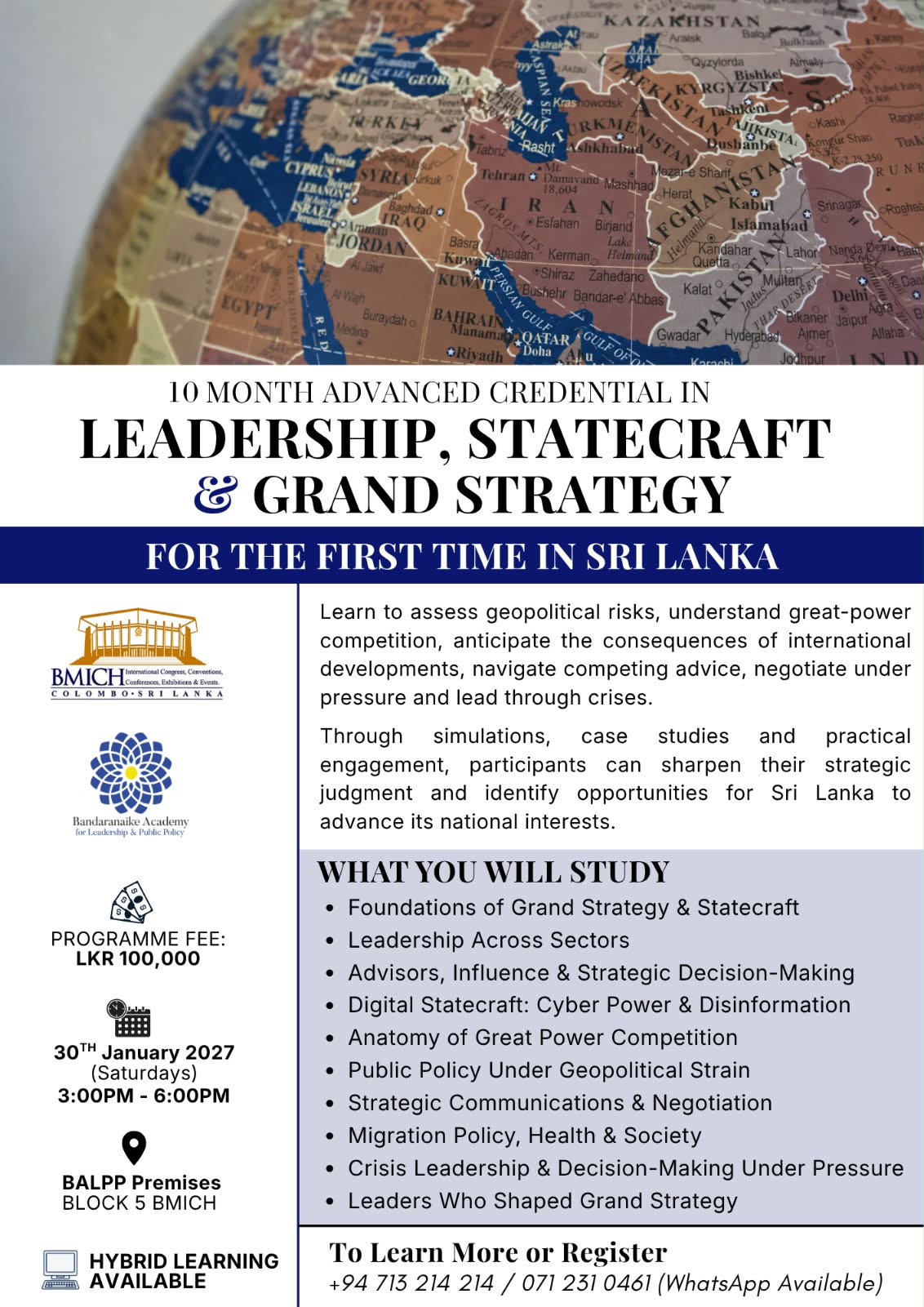
The Leadership, Statecraft and Grand Strategy Advanced Credential (LSGS) is a 10-month executive education programme by the Bandaranaike Academy for Leadership and Public Policy (BALPP), offered for the first time in Sri Lanka. It is designed for leaders who make decisions in volatile geopolitical and institutional environments.
Decisions once confined to foreign ministries and defence establishments now land on the desks of every senior leader. Geopolitical rivalry, energy and supply-chain shocks, migration pressures, cyber and information threats, and overlapping crises demand leaders who can think in terms of grand strategy and act with the skill of statecraft. LSGS brings together, within a single programme, the theory, frameworks, and practical tools needed to read a shifting international order, weigh competing advice, communicate with credibility, and hold steady under pressure.
The programme integrates grand strategy, leadership, decision-making, digital statecraft, public policy, negotiation, economics, and crisis management, drawing on Sri Lankan, regional, and global case studies. It pays particular attention to how states like Sri Lanka, with limited power but real room to manoeuvre, build strategy and find leverage.
What Distinguishes LSGS
LSGS is built for leaders who must act, not just analyse. It offers:
- Grand strategy and statecraft as a connected body of thought (the thinking) and practice (the doing)
- Strategy for small and middle states: how countries like Sri Lanka exercise statecraft and find leverage despite limited power
- Digital statecraft, including cyber power, disinformation, and the use and limits of AI in security and analysis
- Policy under geopolitical strain: energy, sanctions, supply chains, migration, and the protection of national institutions
- Resilient leadership: managing compound crises while sustaining composure, judgment, and credibility
- Cross-sector perspectives for public, private, and development sector leaders, taught by practitioners and academics
- Sri Lankan and regional contextual depth alongside global strategic benchmarks
Programme Structure
- Duration: 10 months
- Start Date: 30 January 2027
- Modules: 10 modules, each built around two subtopics
- Sessions: Weekly (Saturdays, 3.00 PM – 6.00 PM)
- Format: On-site at BALPP, Block 5, BMICH (hybrid learning available; in-person participation strongly encouraged)
- Session Length: 3 hours
- Course Fee: LKR 100,000/-
The programme also includes curated exposure visits aligned with course themes, held on weekdays. Optional study tours to strategic locations are available separately for a fee.
Learning Experience
LSGS is highly interactive, case-study based, scenario-driven, and peer-led, not lecture-heavy. Learning is reinforced through:
- Case-based discussions and scenario exercises
- Peer learning and collaborative problem-solving
- Exposure visits and immersive learning experiences
- Skill development exercises
- Interaction with guest practitioners and subject-matter experts
Module Outline
The programme consists of ten modules:
- Foundations of Grand Strategy and Statecraft
- Leadership Across Sectors
- Influence in Statecraft: Advisors and Decision-Making
- Digital Statecraft: Cyber Power and the Information Domain
- Great Power Competition Today
- Statecraft at Home: Public Policy Under Geopolitical Strain
- Power, Persuasion, and the State: Communication and Negotiation as Instruments of Leadership
- Migration Policy and Statecraft: Economy, Health and Society
- The Resilient Leader: Managing Multiple Crises and Sustaining Composure
- Leaders Who Shaped Grand Strategy
Who Should Apply
LSGS is designed for driven, adult learners and mid-to-senior leaders who make decisions that matter across sectors, including:
- Mid-to-senior public servants and civil service leaders
- Diplomats, security sector, and defence professionals
- Corporate managers and executives
- Political and policy staffers
- Development sector and NGO/INGO professionals
- Journalists, researchers, and policy analysts
- Entrepreneurs and start-up founders
Certification Requirements
To be awarded the ASAC, participants must:
- Maintain a minimum of 60% attendance
- Successfully complete all assessment components
- Adhere to BALPP’s code of conduct