


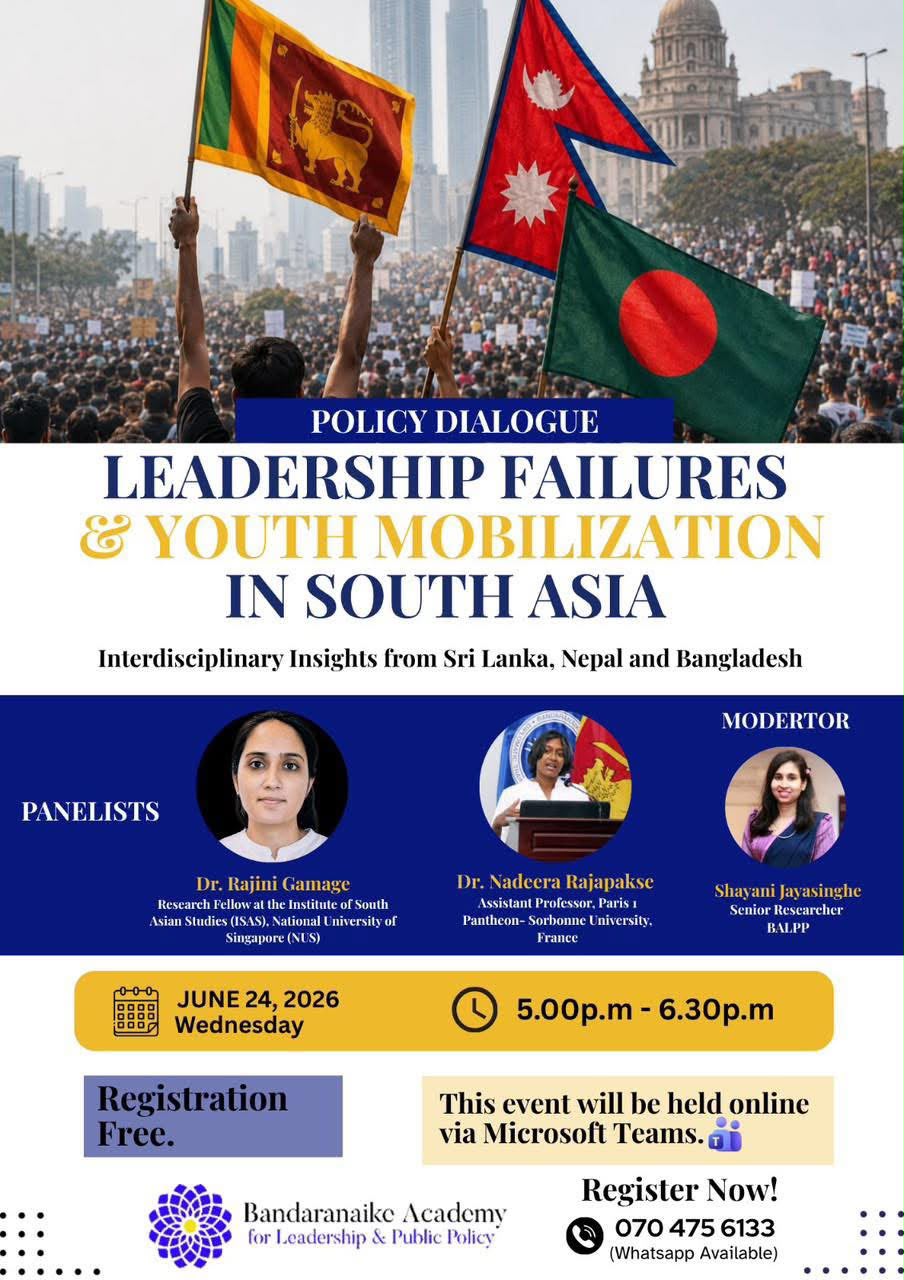
Online Policy Dialogue – Leadership Failure & Youth Mobilization in South Asia
The Bandaranaike Academy for Leadership & Public Policy (BALPP) conducted a Policy Dialogue titled “Leadership Failures & Youth Mobilization in South Asia: Interdisciplinary Insights from Sri Lanka, Nepal and Bangladesh” on 24th June 2026 via Microsoft Teams.
The dialogue examined the political and institutional circumstances that contributed to youth-led mobilisation in Sri Lanka, Nepal and Bangladesh, exploring the relationship between failures of political leadership, declining public confidence in institutions and the emergence of youth movements as significant forces for political and social change.
Bringing together academic perspectives from across different disciplines, the discussion explored the common factors underlying youth discontent in the three countries, including governance challenges, institutional accountability, political representation and the growing disconnect between established political leadership and younger generations. Particular attention was given to the role of youth movements in challenging existing political structures, influencing public discourse and shaping demands for political reform.
The panel featured Dr. Rajini Gamage, Research Fellow at the Institute of South Asian Studies (ISAS), National University of Singapore (NUS), and Dr. Nadeera Rajapakse, Assistant Professor at Paris 1 Panthéon-Sorbonne University, France. Drawing on their respective academic expertise, the panellists provided interdisciplinary perspectives on the political developments and youth mobilisation movements in South Asia.
The discussion was moderated by Shayani Jayasinghe, Senior Researcher at BALPP, who facilitated the exchange of perspectives and examined the regional dimensions of the issues under discussion.
The dialogue provided an opportunity to consider the broader implications of youth-led political movements for democratic governance, political accountability and the future of leadership in South Asia. It also highlighted the importance of understanding youth mobilisation within its wider political, economic and institutional context, particularly as countries across the region navigate changing expectations of leadership and democratic representation.